Thursday
Oct262017

Supercross Fitness!

What Supercross Racers Can Teach You About Your Own Fitness

"I don't think anyone realizes the exertion these guys manage during a race."

October 26, 2017

motocross heart rate
AMA Supercross

When you're racing a motorcycle, your heart beats as fast as humanly possible. Whether you're hopping along the straightaways or jumping a bike 20 feet in the air, you need to stay focused and ward off the distractions of a roaring crowd and constant fireworks.

At the Monster Energy AMA Supercross in Las Vegas, rider Marvin Musquin overcame all of those challenges and more to take home $1 million — the second rider ever to claim a seven-figure check from the competition. This year's competition was also unique in another respect: for the first time, every racer on the dirt wore heart monitors that not only recorded their exertion levels throughout the race for trainer analysis, but also broadcasted that same real-time data to the stadium’s screens.

motocross heart rate
Photograph courtesy of AMA Supercross

During the competition in Las Vegas, riders wrestled 200+ pound bikes around banked turns and over 20-foot jumps, their hearts spiking above the 190 BPM mark and staying there for 15 laps. The heart rate displays showed this spike in real time, providing a fun gimmick to bring fans closer to their favorite riders.

The race organizers hoped the heart monitors would help fans understand how hard the racers work. But the data also served another purpose: to help trainers and medical professionals understand heart function and recovery during any athletic competition.

The tracking tech was created by LITPro, a Temecula, Calif.-based developer of race-tracking software. LITPro President Michael Ford says LITPro needed to upgrade its existing technology before its new heart monitors could work. Using a form of GPS, LITPro had to track the racers' rapidly beating hearts, turn to turn and jump to jump.

“We had to reinvent GPS as it currently only offers a data point every second," Ford explained. "Our HD GPS now reports 20 times per second. That allows us to add other metrics such as acceleration and G-force to our heart rate monitoring.”

Examining heart rate and recovery offers tremendous insight into how efficiently the human body works. Musquin, for instance, utilizes LITPro’s heart rate monitoring technology for races, practices and time trials, but he also has the unit attached while exercising with fitness expert Aldon Baker.

“We’re learning that the primary signs of fitness are heart rate and recovery,” Baker told Men's Health. "The biggest challenge I face is trying to find ways to train Supercross athletes up to the same heart rates as when they race. These guys have been racing since they were five years old, so they’re not afraid out there during a race. But their heart rates are still higher at race time than at any other time. That’s all adrenaline — all competition.”

To push his riders’ fitness levels as close to race conditions as he can, Baker has them switch between practice riding to intense cardio and strength training days. Regardless, the athletes do some cardio every day unless they are injured.

motocross heart rate
 

Ford and Baker foresee all of this training and racing data finding its way into the mainstream fitness realm. After collecting and analyzing all of the heart rate data, Ford and LitPRO want to take their findings to other circuits and sports beyond motor-racing to aid a wider swath of athletes in training.

Still, there's something exceptional about Supercross.

“I don’t think anyone realizes the exertion these guys manage during a race,” Ford said. “Football players get a break after every play. Basketball players stop for fouls. Our racers have to manage that bike with the throttle wide open, against G-forces and through all the impacts. That’s why this is the perfect sport to drive this research.”

Saturday
Sep232017

Why Cycling is the Best Way to Lose Weight


Want to lose weight and keep it off? Here’s why ​the first fitness machine you ever owned is still the best

By ​Selene Yeager September 22, 2017


Having worked as a certified fitness trainer for 21 years, I’ve long since come to the conclusion that if you’re looking for the best exercise to shed a few pounds—and keep them off—nothing beats cycling. Over the years, I’ve seen clients shed half their size and heard from readers who have lost more than 100 pounds by adding cycling to their weight loss arsenal, which, yes, must include a healthy diet. (But you already knew that.)

So what makes cycling so special? In short, it makes you happy, says Jimmy Weber, of Enid, Oklahoma, who at 6’2” and 260 pounds is not a small rider, but is now 150 pounds lighter than his max weight of 410 pounds seven years ago. He initially shed weight through bariatric surgery and walking—a lot of walking. But walking his usual seven miles a day got boring and running was out of the question—“I’m too big and the impact would damage me more than benefit me,” he says. Although he has a membership to the Y, he says he has a hard time making himself go. The bike, however, is another story entirely.

Weber bought his first bike in more than 20 years in 2011 and has clocked more than 20,000 miles in the five years that followed, including numerous club and charity rides along the way.

“Bike riding is diverse when it comes to weight management,” he says. “You can go hard and fast and burn a lot of carbs, or slow and steady to burn a lot of fat. Plus I would not be as happy if I had to maintain my weight with diet alone.”

Weber speaks the truth. In case you need more convincing, here’s more great reasons why cycling rules for weight loss.

 Because it’s not all about “exercise.”

The research is pretty conclusive: Most people who exercise only because they know they should, don’t—at least not for very long. Up to 80 percent of people who start exercising throw in the towel within a year. The novelty quickly wears off and they become bored and find things that are more fun to do. But riding a bike makes you feel like a kid. You can go places and explore, pedal through pretty scenery, and feel the fresh air wash over you. You’re not looking at the clock willing your obligatory 30 minutes to go by. You’re enjoying the ride. Oh, and getting some exercise.

 It’s easy to HIIT it hard, no matter your size.

Exercise science shows that high intensity interval training (HIIT) is a fast way to boost your fitness, rev your metabolism, and stimulate human growth hormone, all of which help you ultimately fry more fat. There’s no better place to push those max intervals than on a bike because there’s zero impact, just effort. Just find a quiet stretch of road or path, especially if it’s on a bit of an incline and go. Push as hard as you can for 10 to 20 seconds, go easy for double that time (so 20 to 40), and repeat 8 times. Rest 4 or 5 minutes and do it again.

It’s gentle on the joints.

Cycling is so gentle on your joints it is often recommended as the exercise of choice for people with arthritis and other joint ailments. You need to be sure you have a proper bike fit, of course. But with the right fit and a good warmup, you can push the pace without stressing your hips and knees.

You’ll find friends to get fit with.

Research shows that social support—especially having a workout buddy or two—dramatically increases the likelihood that you’ll stick with your routine, and consistency is key to improving your fitness and shedding unwanted weight. Cycling is such a social sport that, like herds of buffalo and flocks of geese, there’s even a special name for a group of us: a peloton. It doesn’t take more than a quick search to find local cycling clubs where you can meet riders of your same fitness and ability to pedal with.

Even indoors can be really fun.

Most outdoor activities are pretty dreadful when you bring them inside (see: running on a treadmill). But indoor cycling apps like Zwift, Sufferfest, and TrainerRoad, as well as studio cycling classes actually make stationary cycling fun and entertaining. That means you’re less likely to fall out of routine when the weather turns bad.

You can do it all day.

What else can you do for 100 miles? Burning fat was never so much fun as spinning along and chitchatting with your riding buddies for a few hours. Just be smart and limit your snacking to about 200 calories an hour and you’ll create a pound-shedding calorie deficit in no time.

It can fit seamlessly into your life.

The beauty of bikes is that you can get exercise while you’re doing other things rather than having to reserve a chunk of your day to use them for “working out.” By riding your bike to the store, bike commuting to work, and riding instead of driving for other errands, you can slip in hours of activity every week doing the things you’d normally do anyway—and helping achieve a healthy weight while you’re at it.


Thursday
Apr062017

Move It or Lose It!

5 Inspiring Older Athletes That Could Totally Kick Your Ass


Over 50 and still goin’ strong.

Younger athletes at this year’s Olympics like Michael Phelps and Usain Bolt might be household names, but here at Huff/Post 50 we think the older athletes are even more inspiring. They, too, hit the pavement, push themselves to the limit and are in the best shape of their lives.

Here are some older athletes who prove age can’t keep us from accomplishing some pretty incredible things:

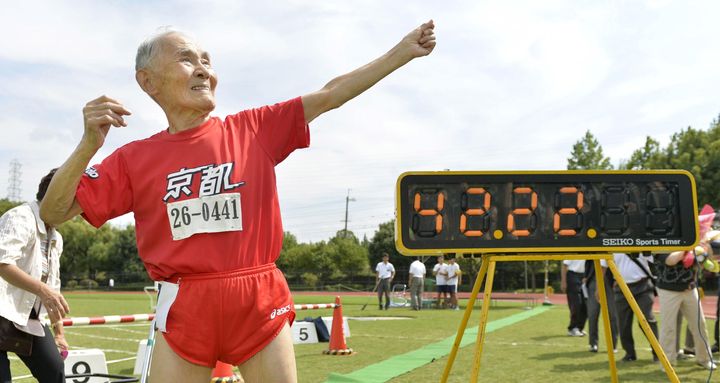
1. Hidekichi Miyazaki 

KYODO Kyodo / Reuters

If you thought breaking a Guinness World Record was cool, imagine doing it at 105. Last September, Japanese centenarian Hidekichi Miyazaki ran a 100-meter dash in a cool 42.2 seconds, making him the oldest competitive sprinter in the world. 

But what’s most inspiring about Miyazaki is that he didn’t even start running competitively until his 90s! With ever the competitive spirit, he says he wished he’d been able to run the dash faster, but not to worry ― he still plans to keep at it for another couple of years. 

2. Charles Eugster

At 97, Charles Eugster has the enviable physique you might expect to see on someone decades younger. But if you ask him, there’s no reason you shouldn’t have a “beach body” at any age. Eugster has said he wants to be turning heads no matter how old he is, but jokes aside, he takes his fitness seriously. 

And his story is truly inspiring. Eugster is the world’s fastest sprinter in the 95-plus category, though he only started running in his 90s. At age 95, he smashed the world record for the 200-meter dash in his age category. His motivation? “Our perception of age is completely faulty ... you can start something new at any age.”

3. Johanna Quaas

Dominik Bindl via Getty Images

Just watching Johanna Quaas on the bars will make your core hurt. The 90-year-old is the world’s oldest gymnast and still looks better in a leotard than most people could ever hope to. The retired gym teacher says there’s no reason you shouldn’t be able to tumble, balance and tuck at every age as long as you keep up with your fitness regimen. 

For her, that means practicing gymnastics twice a week and walking or swimming for an hour every day otherwise. 

4. Fred Winter

Rebekah Romero/ Brooks Institute

Struggling to do a single push-up? There’s a centenarian that can do more than you. That’s at least 100 to be exact. WWII veteran Fred Winter is in the best shape of his life at 101 years young. After deciding to get in shape after turning 70, Winter has been crushing it, competing at various senior fitness competitions and the National Senior Games. Last year he became the oldest person to run the 100-meter dash at the games and took home a few gold medals. 

So how does he do it? Winter is a self-described “health nut” and reportedly still does 100 pushups every day, watches his diet and makes sure to get plenty of exercise. 

5. Lew Hollander

This 86-year-old man of steel, er, iron has completed the ultimate test of endurance and fitness. Hollander holds the record for being the oldest person to complete the famed Ironman competition at 82. He’s kept biking, swimming and running ever since, even competing last year. 

“Move it or lose it,” is his mantra, and he doesn’t take it lightly. Hollander’s fitness routine includes strength training for his body, but he also keeps his mind sharp by playing ping-pong. 

Wednesday
Apr052017

Cardiologist Speaks


Running Helped This Cardiologist Get off His Blood Pressure and Cholesterol Medications

“I now talk to my patients about lifestyle—especially walking and running—as a way to control and even reverse their chronic illnesses and get off of some of their medications.”

By Harvey S. Hahn Tuesday, April 4, 2017, 2:46 pm


Name: Harvey S. Hahn
Age: 48
Occupation: Cardiologist
Hometown: Centerville, Ohio

How long have you been running?
I have been running for four years.

What prompted you to start?
I started running to rehab from a left knee arthroscopy. But I also wanted to lose weight, get healthy, and feel good again.

How often do you run?
I run on average three to four times a week.

What is your routine?
I complete my long run on Sunday, and then over the course of the week I do one interval day, one tempo run day, and one easy run day. I also lift weights two times a week, and do plyometrics once a week. I rest on Saturdays.

Do you race? If so, how often, and what kind of races?
I typically complete two to three marathons, three to four half marathons, as well as three to four 5Ks a year.

Do you engage in other sports or activities? If so, what and how often?
I enjoy swimming and biking with the kids, and I walk and hike as much as I can.

What’s the most rewarding part of running for you?
For me, the most rewarding part of running is how it makes you feel, and how it energizes you and drains away stress.

Please describe your weight loss journey, including your before and after weights.
I really didn’t think I was overweight or out of shape until I tore a meniscus in my left knee and had to use my arms to get out of my car. I had slowly gained 45 pounds since college—back then I was used to playing basketball six days a week. The weight gain was slow and due to the typical excuses—marriage, kids, work, and being tired. After I hurt my knee, I realized that it was because I was carrying the extra 45 pounds around every single step of the day. I also realized that if I didn’t do something, I would be watching my kids play instead of being out there playing with them.

So I went mostly vegan, and started running and using portion control. I got up to three miles at a time, and then went running with a friend and did a hilly five-miler in intense heat. I felt destroyed afterward, but for the rest of the day I felt great, really sharp mentally, and was in a great mood. That’s when I started to run more seriously.

The sad part of this is that I’m a board certified cardiologist who was being treated for high blood pressure and high cholesterol, and I wasn’t trying to work on my weight or lifestyle at all. After making these changes and dropping weight, I got off of my blood pressure pill (Norvasc) and my cholesterol pill (Lipitor) and my numbers are even better now then when I was taking the medications. I now talk to my patients about lifestyle—especially walking and running—as a way to control and even reverse their chronic illnesses and get off of some of their medications. 

What is the secret to your weight loss success?
The secret to my weight loss success is motivation. Trying to lose weight to just get a six pack isn’t a strong enough motivator to make real lasting changes. I wanted to set an example for my two boys so that they wouldn’t have to fight weight and chronic illnesses when they get older like I did. I also wanted to be a good example for the patients that I take care of.

The operational secret to my success is making my exercise and eating routine a habit so that I don’t have to use up any will power on it. 

How do you stay motivated?
I just have to look at my kids. They used to be chubby, but not anymore. I want them to have as full of a life as possible. I also plan races year round to keep me on my training program, and I run races with friends at all distances in order to keep it fun.

Do you have any favorite motivational quotes?
“Genetics loads the gun, but behaviors pull the trigger.”

“Do, or do not! There is no try.” —Yoda

“The reason most people never reach their goals is that they don’t define them, or ever seriously consider them as believable or achievable. Winners can tell you where they are going, what they plan to do along the way, and who will be sharing the adventure with them.” —Denis Waitley

“You must be the change you want to see in the world.” —Ghandi

“We do not act rightly because we have virtue or excellence, but we rather have those because we have acted rightly. We are what we repeatedly do. Excellence, then, is not an act but a habit.” —Aristotle

“You must own everything in your world. There is no one else to blame.” —Jocko Willink, Navy Seal

“There is no way to happiness; happiness IS the way.” Thich Nhat Hanh

What are your current short and long term goals?
I’ve completed nine marathons, but I haven’t gotten lose to qualifying for the Boston Marathon. I want to BQ and run it at least once. I also want to do a 50K or 50-miler before I turn 50.

Is there anything else you’d like to tell us?
Dropping 45 pounds is nothing compared to some of the other stories I’ve read, but if someone who is supposed to know about health can let themselves get so unhealthy—that’s a problem. If doctors would treat, teach, and lead by example we could make a huge dent into obesity, diabetes, and chronic illnesses and at the same time help people live a better and fuller life.


 

Tuesday
Feb282017

Cycling Workouts

3 High-Cadence Cycling Workouts for Base Training


Read more at http://www.triathlete.com/2017/02/training/3-high-cadence-cycling-workouts-base-training_298928#MVcJ6BG24oh8O0So.99
Page 1 ... 7 8 9 10 11 ... 28 Next 5 Entries »