Friday
Dec072018

Hospitalised: Stefan Everts

Stefan Everts falls ill after trip to Congo

Friday, 7th December 2018

It was reported today that Stefan Everts, a ten-time world champion, is currently in intensive care at a local hospital. It is thought that Everts recently contracted malaria during a trip to Congo, where he was taking part in the Mikembo charity programme.

Everts raised five thousand six hundred and seventy-two dollars for the programme with his jersey alone. Additional details are obviously sparse currently, but updates will be added to this post when they are made available. Everyone at MX Vice wishes Everts and his family well in this difficult time. 

Words: Lewis Phillips

Friday
Dec072018

Malcolm's Bike Stories

Hear Malcolm share amazing stories from his legendary past, and the bikes that took him there.


Thursday
Dec062018

F&H Kawasaki Team!

Marc De Reuver interview - 2019


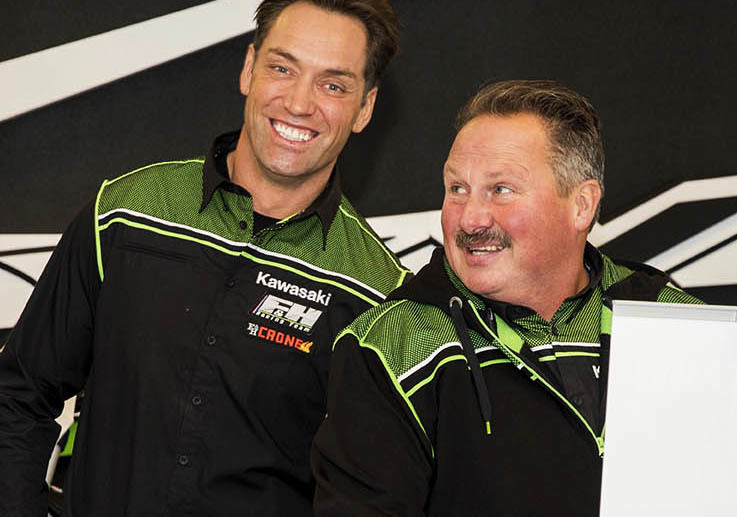
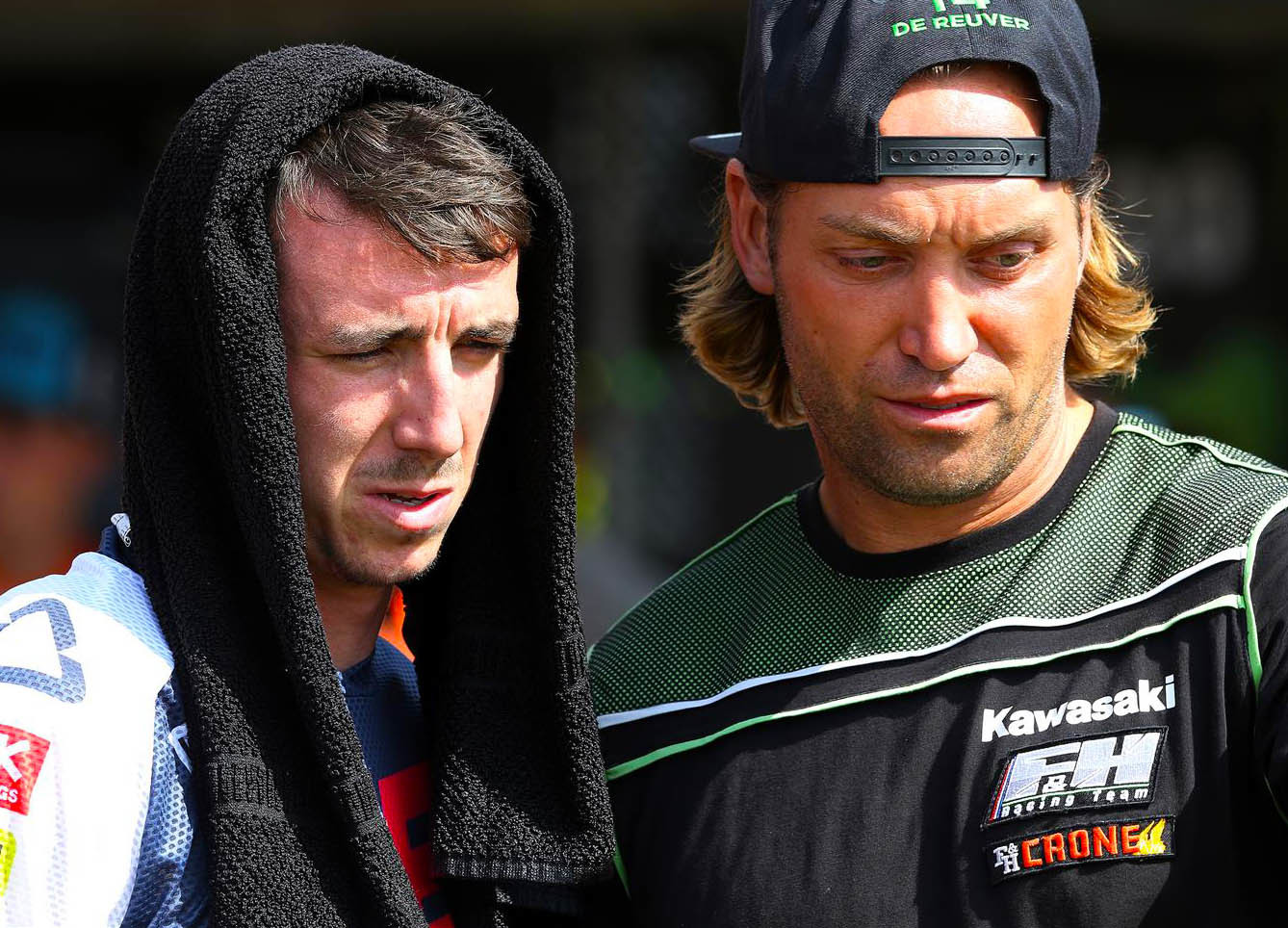
Marc De Reuver of the F&H Kawasaki team knows something about how a team has to be, to be successful. The Dutchman, who races for factory teams with KTM, Yamaha and Honda, and won a handful of GP’s, is excited for 2019, and he has every right to be.

It should be pointed out, De Reuver helped Pauls Jonass to a World MX2 championship, and then worked with Jed Beaton, who did well enough to pick up a factory ride with the Husqvarna team. Its little surprise that riders perform under the eye of De Reuver. His knowledge in the sport is huge and while he trains the riders, he is also giving them daily advice on how to keep it real, in a sport that takes more prisoners than not.

De-Reuver-and-boss.jpg#asset:12816

MXlarge: Marc, everyone is preparing for the 2019 season, and I know the team opened their work-shop last week, and it seems like the team continues to progress?

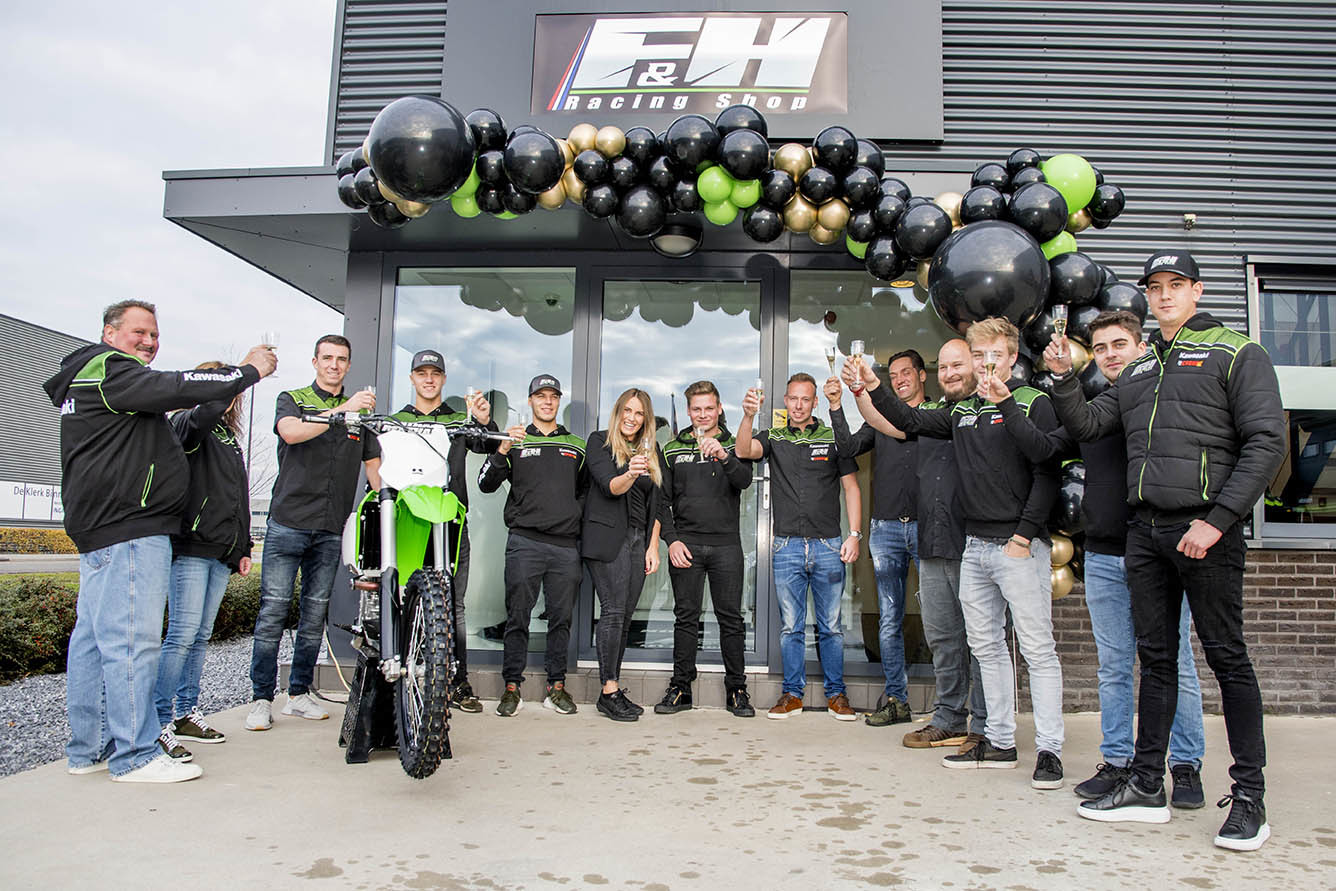
De Reuver: It does Geoff. They opened their store, selling Kawasaki machines, parts, tyres, and other products. It’s a really beautiful facility.

MXlarge: How professional has the team gotten over the last 12 months?

De Reuver: People don’t understand, 12 months ago, there was nothing, and they built it up to a mega team, it’s like a factory team. We are private and doing our own thing, but it’s like a factory team.

MXlarge: I was speaking to somebody on Monday, and we were talking about how much the F&H Kawasaki team has improved.

De Reuver: Steve Guttridge from Kawasaki was in our work-shop this week, he was really impressed with it. Also the big boss from Kawasaki Europe. You know, I am from Amstelveen and so is he, and we had a good connection straight away. It was a nice day.

MXlarge: This year, not only has the team grown, but the whole team.

De Reuver: What has improved a lot, is the bike. The whole package is so much better, really a top bike. With Adam Sterry, Henri Jacobi, Roan van de Moosdijk. Roan will ride in the EMX. I can only be very happy on this moment seeing how we have progressed.

FH-Opening_40shotbybavo_DSC_6889-72dpi.jpg#asset:12817

MXlarge: Speaking of Jacobi, I did an interview with him about a month ago, and he mentioned how big an improvement it was to move to the F&H Kawasaki team, with the support and everything. How has he been coming on in your eyes?

De Reuver: He is really good. What I see from him now, and how surprised he is with things I tell him, and how he improves from that, I am very surprised he was able to be top five before. The things we are teaching him, even just daily life, if he keeps improving, we have a serious rider. But the same with Adam (Sterry). Last year he came to me a little broken, but now he can start my program from the beginning, and you see the improvement. They are all training together and even if Roan might be faster sometimes, they don’t care, because he is EMX, but it helps each other to train together.

MXlarge: Tell me about Van de Moosdijk. We have heard about him for years, and he is obviously Dutch. What is his potential?

De Reuver: He has just turned 18 and he was third in the EMX and people said he should go straight to MX2, but the problem with that, moving to the MX2 can make you, or break you, and he is just 18, so he will still have four years in MX2 when he moves up in 2020. He might do some GPs, but if he is leading the EMX, then we won’t risk putting him in the MX2 class.

MXlarge: It is a difficult one, because some riders can move up quickly, like a Herlings, or Prado, but not everyone can be 18 and move into the World championships?

De Reuver: That is why I wanted him to stay in EMX, I talked to my boss and fortunately he listened and I think this will work out great. Look at Lupino back in the day, he moved up too quickly and it has taken him years, because it broke him at that time.

MXlarge: Obviously having a guy like you involved, somebody with so much experience, that has to be the bigger factor that helps these younger riders?

De Reuver: Yes, but I am not just a trainer, like I was with Jonass and Jed. I stay with Roan in the hotel room, and the learning continues.

De-Reuver-lead.jpg#asset:12815

MXlarge: Like a father figure?

De Reuver: More like a big brother. I am so super pumped about 2019, just really happy.

MXlarge: But what is the potential of Van de Moosdijk, a GP winner?

De Reuver: Yes, 100%, but people forget, look at Lesiardo from 2017, he was strong in EMX250, but this year, he did nothing. This is how critical in this period, it can make or break you. Look at Jed, he is now a factory rider. Look at Prado, he wasn’t consistent in 2017, but then he got the structure in 2018, and you see the difference. He went from being not consistent be being World champion.

MXlarge: What I find amazing, when you look at the top guys, a lot of guys have that inner circle, be it parents, or good friends. Jeffrey has his inner circle, that has been like that for probably 10 years, Antonio has Jill, and De Carli, and a circle of good friends. That inner-circle seems to be everything for a rider?

De Reuver: Yes, you need a family feeling and for some riders dads don’t work at all, and I am not a big fan of fathers being involved, it can break your career. Your dad doesn’t have to say anything, you just see his face and you know. That can also break a rider. I had a good connection with my dad, but also some days not.

MXlarge: Saying and doing the correct thing with a person isn’t easy. It doesn’t matter if it is just in normal life, or to a sportsman. What about Adam (Sterry), what does he need to improve?

De Reuver: I have three guys who are very different and you need to talk to them differently and be aware of what they need to hear. Adam, he needs to improve in the racing. In Lommel, in the warm-up he was the fastest rider and everyone in the team was very happy, but I looked into his eyes when he went to the start gate, for the first moto, and I saw in his eyes, that it wasn’t going to happen in the moto’s. He needs to bring what he does in practice into the races and I think he will in 2019.

De-Reuver-and-Sterry-talk.jpg#asset:12819

MXlarge: Is that mentally preparing him for what might happen in a race?

De Reuver: But that is what I say, I am not only a trainer, and the difficult part of my job, these guys are not all the same. Roan is different, and Henry is a little over confident, so I need to be less with him. Adam doesn’t get overexcited, but if you are a second faster than Jonass and two seconds faster than Prado in practice, you need to switch some buttons in your head, because it doesn’t always go as you might think.

MXlarge: And what are the riders doing now until the pre-season races?

De Reuver: We did two weeks in the sand in Holland, and now we are in Spain and then they ride at home and from Christmas until New Year they won’t ride, then we ride at home, then two weeks in Spain, before heading to Ottobiano for our first race. We will also do Hawkstone Park in England, and Lacapelle in France.

Thursday
Dec062018

Argentina Confirmed As Opening Round Of 2019 MXGP

Monday
Dec032018

Born to Race trailer

Preview of mini-documentary featuring Brett Metcalfe.

Born to Race delves into the life of former international and Penrite Honda Racing ace Brett Metcalfe, detailing his career and the journey along the way. The mini-documentary is due for release at the conclusion of 2018.

Monday
Dec032018

KTM Rally Team launched ahead of Dakar 2019

First look: KTM Rally Team launched ahead of Dakar 2019


Matthias Walkner, Toby Price, Sam Sunderland and Luciano Benavides head the KTM Rally Team attack in final preparations for the 2019 Dakar Rally in Peru. 


With one final test in Abu Dhabi on the cards, the Red Bull KTM Factory Racing riders and team are all set for the 41st Dakar, this year raced entirely in Peru. 

The exceptionally strong KTM team includes three previous Dakar winners who will fight for the Austrian manufacturer’s 18th consecutive victory at Dakar. Supported riders Laia Sanz and Mario Patrao

Following an incredible season, that saw Matthias Walkner crowned 2018 Dakar Rally Champion and Toby Price crowned FIM Cross-Country Rallies World Champion, the focus has now switched firmly back to the Dakar and the 2019 event that kicks off on January 6. 


KTM Dakar Team 31 2019 Enduro21 560


Matthias Walkner

As 2018 Dakar champion, Matthias Walkner will head to Peru with the number one plate on his bike. Despite a tricky start to this year’s world championship campaign, Walkner soon found his rhythm onboard his KTM 450 RALLY. Strong finishes at the final few rounds of the season, including runner-up results at the Desafio Inka and Rallye du Maroc, showed that the Austrian rider is on form and ready to take on the Dakar once more.

Matthias Walkner: “I’m looking forward to getting back on the bike in Peru and racing to defend my title. There is a little bit of added pressure for me but my plan is exactly the same as always – stay safe and do my best at the event. 

“It’s difficult to know how things will be with the race held in just one country and with so much of it in the sand. Strategy will be very important as your start position for the day can make a huge difference to the results. 

“I believe it will be very close with a lot of guys fighting for the win, but if everything goes to plan and I can keep to a consistent pace, I would hope for at least another podium finish.” 


KTM Dakar Walkner 16 2019 Enduro21 560


Toby Price

Having accepted his official 2018 FIM Cross-Country Rallies World Championship medal in Andorra at the weekend, Toby Price will arrive at Dakar in strong form. Like his teammate, Price started his 2018 season with mixed results but a late charge took the Australian to victory at the final round in Morocco and with it he secured his first ever world championship. The 2016 Dakar champion aims to carry that form into Peru and the fast-approaching 2019 event.

Toby Price: “2018 has been an incredible year for me. Finishing the Dakar on the podium in third after only just coming back from injury was great. The world championship didn’t start quite like I would have hoped, but I was able to keep my head together, stay consistent and the results finally came. Everything clicked in Morocco at that final round and I’m hoping for something similar in Peru. 

“It’s going to be a bit of a strange Dakar, the route looks like about 70 percent is in the dunes and it’s going to be a real challenge, certainly no time to relax. In the past there have been days where you can pace yourself and still get a good result by concentrating on navigation and riding smooth – on this one I think it’s going to be flat-out from the very beginning.” 


KTM Dakar Price 22 2019 Enduro21 560


Sam Sunderland

Forced to retire from the 2018 Dakar due to injury, Sam Sunderland was subsequently fighting for the win at the first rounds of the world championship when a further injury caused him to miss races. 

Regrouping for the final round in Morocco, and despite a tyre issue causing him to lose time early on, the British rider was impressive in the sand which will help in Peru at this year’s Dakar.

Sam Sunderland: “As we get closer to Dakar now, I’m feeling really good. I’m happy with how I am riding and confident in my navigation. I know this year in Peru it’s going to be very physically demanding, so I have been working very hard on my training to be in the best shape when the race starts in January. 

“It’s definitely good for me that we have 10 days in the dunes. I love riding that sort of terrain and seem to have good pace there. Whether it will fall in my favour I don’t know. Anything can happen in rallies as we know and you can’t predict a race like Dakar. 

“This year (2018) I did have a six-minute lead after Peru so that is encouraging, but the plan is the usual – take each day as it comes.” 


KTM Dakar Sunderland 7 2019 Enduro21 560


Luciano Benavides

Riding the full Red Bull liveried KTM 450 RALLY for the first time at Dakar 2019, Luciano Benavides is hoping to make up for his early departure from the 2018 event. 

Luciano Benavides: “It’s an honour to ride with the Red Bull colours on the bike. It carries a lot of responsibility and some added pressure, especially as I am riding with three Dakar champions. But I will try my best to turn that into motivation to do well. 

“My second goal is to finish inside the top-10. I know that will be tough and I think with the shorter rally in 2019 it will be even tougher, but I know I have the pace to do so.” 

 
KTM Dakar Benavides 20 2019 Endueo21 560
 

Laia Sanz

Joining the four-rider Red Bull KTM Factory Racing team in Peru will be Laia Sanz and Mario Patrao. The two KTM Factory Racing riders will both be gunning for strong results at the 2019 Dakar Rally. Sanz will be returning to competition proper following her recent fight with the Epstein Barr virus. 

 
KTM Dakar Sanz 7 2019 Enduro21 560
 

Starting January 6 in Lima, the 2019 Dakar Rally covers 10 full days of racing with one marathon stage and one rest day before the riders return to Lima for the finish on January 17. The total distance covered by the motorcycles will be 5,541 kilometres – 2,889 kilometres of which will be timed special stages.

Photo Credit: Sebas Romero


Tuesday
Nov272018

The Godfather’s Disciple 

Seasoned veteran and 9-time World Champion Antonio Cairoli is on his quest for a 10th World Title. While on that quest, he mentored 17-year old Jorge Prado and was one of the key ingredients that helped the young Spaniard win his first MX2 title. The speed and energy of Prado may be the spark Antonio needs next season to one day match Stefan Everts's 10 World Championships.


Sunday
Nov252018

Chad Reed Claims Inaugural FIM Oceania Championship In Auckland


Click to view larger image of Chad Reed claims the inaugural FIM Oceania Championship in Auckland Chad Reed claims the inaugural FIM Oceania Championship in Auckland


Australian Chad Reed has won the inaugural Monster Energy S-X Open International Supercross FIM Oceania Championship in front of a huge crowd at Mt Smart Stadium on Saturday night.

Reed left the entire field in his wake to win all three feature races at the Monster Energy S-X Open Auckland, to make a remarkable run to victory on the night, and of the overall Oceania championship.

“Oh man, I’m so stoked to become the first ever FIM Oceania Supercross Champion!” Reed said

“Coming back to NZ is always awesome, this crowd was amazing and for me, I’d love to be back and defend my title and supporting this championship.

“We had some epic battles in Sydney and tonight in Auckland and with that bit of rain in the morning I just rubbed my hands together and everything just came together today.”


Click to view larger image of The FIM Oceania Championship podium The FIM Oceania Championship podium


Kiwi ace Ben Townley put in a sweet show for his home crowd, going bar-to-bar with rival Ronnie Mac to win the Boost Mobile International Showdown.

The pair traded blows on the track before literally trading blows off it to cap off a huge win for the ANZACs over the Internationals.

“The showdown went to plan, Ronnie jumped the gun as I expected so I had to trail him all the way to the last corner, and was able to sneak up the inside and just pile drive him into the dirt and yeah that was it, he was on the floor and I was able to get the victory for the ANZACs,” Townley said.

“This event just goes to show that motorsport as a whole, there’s appeal for events of this calibre and I know there were Kiwi kids in the stands tonight dreaming of being the next Chad Reed in the future so the sport is bright for us, we just need to capitalise on the success of this event.”

Front runnere Brett Metcalfe and Dan Reardon were both sidelined with injury. Reardon damaged his ankel when a banner pulled his brake on off a jump causing him to come up short of the huge finish line jump while Metcalfe hurt his wrist in a first turn crash in moto 1.


Click to view larger image of Kiwi and former World Champion Townley was a huge hit with the Auckland crowd Kiwi and former World Champion Townley was a huge hit with the Auckland crowd


In the SX2 class, it was American ace Dakota Alix who took the spoils form Aussie Ryan Marmont with local kiwi Josiah Natzke claiming the final podium spot.

With no Supercross series in New Zealand, it was a huge challenge for Natzke on the world-class track but the youngster was up to the challenge to finish as the fastest Kiwi for the event.

“Us Kiwi’s don’t have Supercross so this event means a lot really,” Natzke said.

“I think there were lots of people here tonight who don't have anything to do with moto so it’s just good for the whole thing, it’s good for the riders, the young people coming here, there are heaps of young kids out here tonight, so it’s just mint for everyone.”

The FIM Oceania Supercross Championship saw Reed win with Scotsman Dean Wilson in second and American Justin Brayton in third.

Meanwhile, for the S-X Open event results, Reed’s win was followed impressively by up and coming Aussie speedster Hayden Mellross with Wilson in third.

The Monster Energy S-X Open Auckland was hailed a huge success with 21,126 screaming fans on hand to witness the inaugural running of the event.


Click to view larger image of Local kiwi Josiah Natzke claimed the final podium spot in SX2 class Local kiwi Josiah Natzke claimed the final podium spot in SX2 class


Monster Energy S-X Open International Supercross FIM Oceania Championship
1. Chad REED (AUS)
2. Dean WILSON (SCO)
3. Justin BRAYTON (USA)
4. Luke CLOUT (AUS)
5. Jason ANDERSON (USA)
6. Dylan LONG (AUS)
7. Lawson BOPPING (AUS)
8. Daniel REARDON (AUS)
9. Hayden MELLROSS (AUS)
10. Christian CRAIG (USA)

Thursday
Nov222018

Sierra OT Annual Toy Drive

Once again the Sierra Old Timers club showed they are about more than just riding. They held their annual Christmas Toy Drive at Prairie City OHV park. They combined a club private ride day with gathering toys for children in need of some Christmas joy. The club topped the day off with a free dinner at the Auburn Ale House in Auburn, CA. Great riding, Great food and a great cause!

Wednesday
Nov212018

START THE FOUR-STROKE REVOLUTION WITHOUT ME!

By Willy Musgrave


You may have heard of me, and you may not have—that isn’t all that important to this tale. This is my story from eight years ago—when I came to a realization that I hope will inspire others. Go back in time with me as I relive the two-stroke versus four-stroke war on a personal level.

For some background, you should know that I’ve been around the block in motocross. I graduated from MMI, worked in dealerships, was the production manager for ATK, got the patent for an exhaust system used by the White Brothers, raced in the 2001 Motocross des Nations World Cup race for the Czech Republic team, won a round of the World Supercross series back in the 1980s (in Pune, India), spent 20 years as an MXA test rider, and raced the AMA Nationals and FIM GPs. Today, I’m just another motocross racer who enjoys the sport, but late in the 2010 racing season I got involved in a nutty experiment that is worth sharing.

The whole crazy idea started back in 2010 when Tyson, one of the salesmen at the MTA distributing company, bought a 2001 Honda CR250 two-stroke that he was trying to sell for $800. At first glance, the bike looked pretty torn up. However, after closer inspection, I thought that it had some potential—although my vision was probably blurred a little by current events. The timing for this could not have been any better. I had been going through a phase in my life where I didn’t want to race with the same intensity that had driven me for the last 25 years. The reason for my disenchantment was really simple—I didn’t have that much fun riding a four-stroke. Oh, don’t get me wrong. I owned one; I raced one and knew how to work on it—I just felt that there had to be a better way.

I’m not the first person to come to this conclusion, but it is obvious to me that the cost of a new four-stroke is way too high. The expense of maintaining them is also cost prohibitive. Then, after the fact, the resale value is terrible. I’m not crying poverty: I’ve work for major motorcycle distributors; I was a magazine test rider, and I have a great relationship with the sponsors I worked with throughout my AMA Pro days. But, even at my level, racing a four-stroke is expensive. The happenstance of Tyson rolling a well-used CR250 two-stroke in the door at the height of my self doubt got me wondering—could I race a two-stroke as fast as I could my full-race, totally modified Honda CRF450?

I knew that if I elected to take on this project, I couldn’t do it halfheartedly. I had to bite the bullet. So, I not only gave Tyson the $800, but I sold my CRF450 to a friend the next day. I had a simple plan in mind. I would ride the bike “as is” before working on it. Then, I would race at it local events in SoCal to shake down my modifications and eventually use it to race the World Vet Championships at Glen Helen. To me, that would be the ultimate test of man and machine.

I went out to Milestone Motocross Park to test ride the stock bike to see if I needed to do anything to it. The answers came fast and furious. The forks were too soft and the shock was too stiff—which is exactly how I felt about my  Honda CRF450 when I first rode it. I guess not much had changed.

I had work to do—more so than the average person, because I wasn’t starting with a cherry bike. This CR250 was 10 years old, and it needed some tender loving care. I cleaned up the bike with a new set of Polisport plastic, a graphics kit, TAG handlebars, White Knuckle grips, Bridgestone 403/404 tires, DID heavy-duty black rims, a DID 520 MX chain, Super Sprockets, clutch plates and a new piston and rings. Finally, I had Pro Circuit revalve the suspension for my speed. Amazingly, Bones had my suspension settings written down in a logbook from when I raced a CR250 back in 2001. The guy is amazing.

My first race on the 10-year-old Honda two-stroke was actually going to be a real workout. Thanks to SoCal’s crazy racing world, I planned to go to Glen Helen on a weekend when they were holding two races on the same day. There was an REM race on the upper track and an International Old Timer’s Club National on the USGP track. If the scheduling worked out, I felt that I could race the three 20-minute Old Timer motos and still squeeze in the two 20-minute REM races on the same day.

The jokes started as soon as I unloaded the CR250 in the morning. I didn’t expect anything less from my friends. “Is there a vintage race here today?” “Did you blow your CRF450 up again?” “Can you pit next to someone else?” “Are you nuts?” I just stood there and took it all in. By the end of the day I would be able to answer all of their questions…and some of my own.

I had not raced a two-stroke since 2007. Oh, I had spun laps on MXA‘s two-stroke test bikes, but never really volunteered to race them. In practice, it took me about four laps to get the cobwebs out. I was a little squirrely as I adjusted to the immediate and abrupt powerband, but I was really surprised how quickly I got back into the groove. At first the bike felt twitchy under braking and wanted to spin the rear tire under acceleration. That feeling went away once I quit riding it like it was a four-stroke. Jumps that I could do easily on my 450cc four-stroke seemed a little harder to do on the two-stroke, but once in the air the two-stroke was so much easier to manhandle. With each lap, my doubts were erased.

The one thing that stood out from everything else was the smile that was stuck on my face. I was having a blast pinning the two-stroke around Glen Helen. Berms that you knew you would blow through on a four-stroke you could now rail on the two-stroke. The flickability difference was something that I had forgotten about. Suddenly I was enjoying riding—and I told myself that even if I got beat, I would never return to a four-stroke.
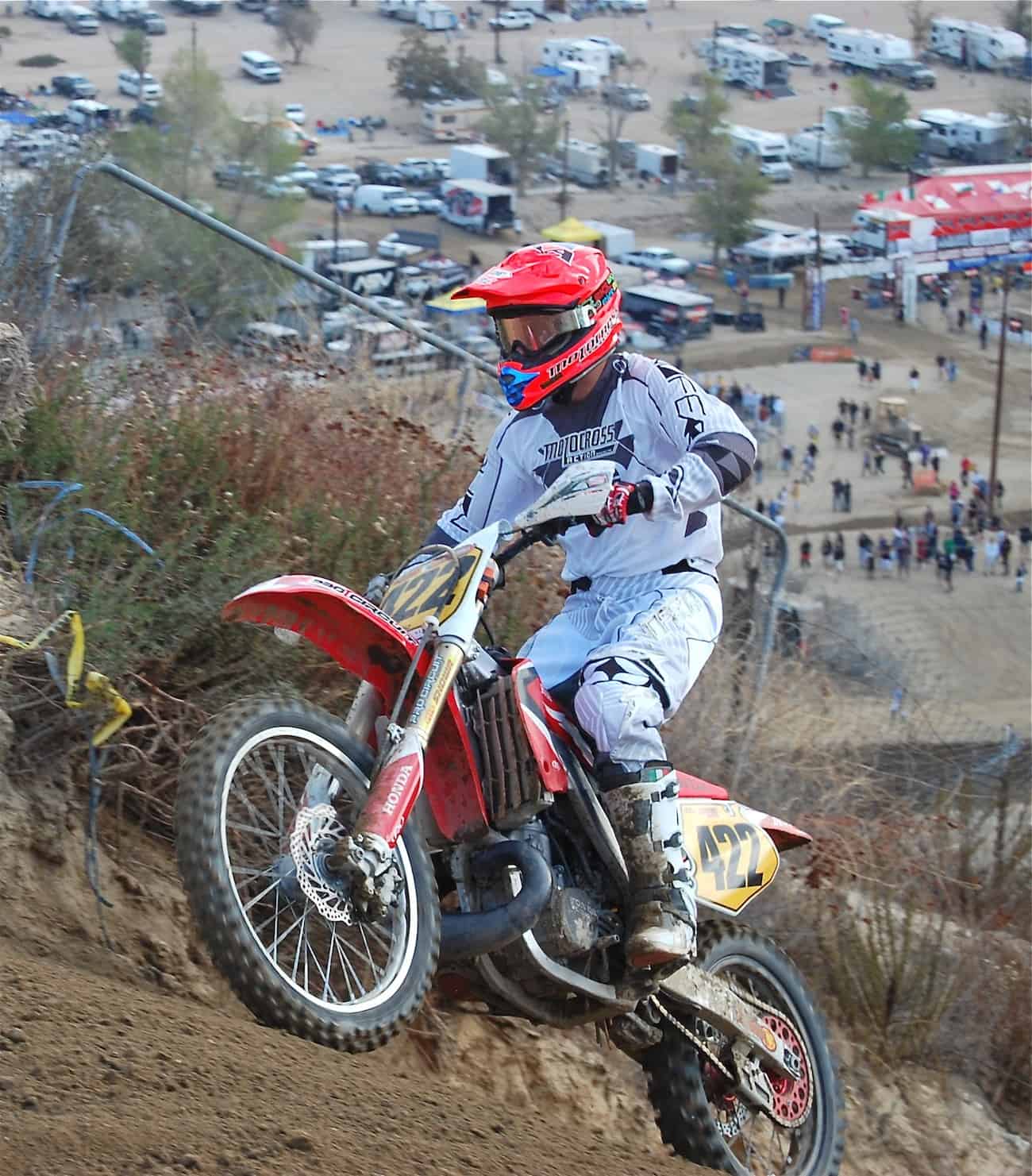
After practice, I got ready for my first race. It would be the Over-40 Master class with the Old Timers on the Glen Helen National track. I was the only two-stroke on a full starting gate. I got a great jump out of the gate and thought I had the holeshot, but Glen Helen’s National start is very long and very fast. By the time I was halfway down the start, (and leading), I was already tapped out in fifth gear. I got passed by a few 450 four-strokes leading into the banked first turn and came out in 10th place (I geared it taller after this moto). I got to fourth place before the first lap was over and, in short order, I had moved into second place behind my old buddy and rival Dan Berg. I followed him for a couple laps to try to analyze what my decade-old two-stroke could do that his brand-new KX450F couldn’t do. Once I realized how much easier it was to charge downhill on a light and responsive two-stroke, I passed Dan for the lead. Northern California pro Eric McKenna worked his way into second place, but when I crossed the finish line, I had a giant smile on my face.

My next race was on the REM track. At REM, they combine classes and start the races in waves to ensure a quick and efficient race program. I was in the Over-40 Pro class at REM, and we were combined with the Intermediates, which included my son Billy. Billy had gone to races with me since he was born, and we had raced against each other ever since he moved up. I knew that as I got older and he got faster, the day was going to come when he would finally beat me. I hoped that it wouldn’t be today.

When the gate dropped, I nailed the start. Pete Murray was right behind me. I wasn’t sure where Billy was, but since he was on MXA‘s YZ125 two-stroke in a field of 250 and 450 four-strokes, I was pretty sure that he couldn’t have gotten a very good start. Shocker! By the end of the first lap, I heard a high-pitched shriek behind me. The race was on! Everyone originally thought I was at a disadvantage by riding a 10-year-old two-stroke, but that disadvantage seems to disappear when a kid on a 125 two-stroke is on your tail. I would be lying if I didn’t admit that I was questioning my two-stroke decision throughout most of the moto. Finally, near the end of the race, I wore Billy out and pulled away for the win. 

Being pushed so hard by my own kid…who I did not want to get beaten by, was actually the best thing that happened to me. The harder I tried, the better I felt. By the end of that race, I had transformed from a four-stroke bus driver into a real motocross racer again. I was charging around the track, and that made it fun. Amazingly, I won all five motos that day…and I think I changed a few people’s opinions.

The 26th annual MTA World Vet Championship would be the real test of my 2001 CR250. The competition in the Over-40 Pro class was incredibly strong. There were riders from all across the USA and many foreign countries—not the least of whom were multi-time World Vet Champion Doug Dubach, 1985 AMA 125 National Champion Ron Lechien, Gordon Ward and former Grand Prix runner-up Kurt Nicoll. The track was rough, and the layout was incredibly demanding.

As I sat on the starting line looking down the long Glen Helen start straight, the Glen Helen track crew rolled out with a tractor and disced the first 100 yards into power robbing mulch. By the time the tractor was done, my chance of getting a good start on a two-stroke had vanished.

Oh yeah, it came to me that the reason I had switched from two-strokes to four-strokes back in 2007 was because of starts like these. I immediately changed my plans about starting on the inside of the long Glen Helen start and moved all the way to the outside—where I found myself sitting next to three other two-stroke riders who had the same idea. We all planned to come from the outside and leave our bikes pinned around the outside of the 45-degree banked Talladega first turn. It was a great idea, but it didn’t work, because the torque of the 450 four-strokes powered through the disced dirt so well that I found myself mid-pack. I put my head down and started charging. I moved from 16th to seventh by the checkered flag. Dubach won on a YZ450F, with Ward, Lechien and Nicoll on his tail. I was the first two-stroke.

There was no strategy that could get me to the front of the pack through that disced wasteland off the gate. My second moto start was about the same, but I started to make moves sooner. The track was much rougher, and I was having some epic battles. I could really tell where my advantages were compared to the four-strokes. In most of the rough sections, rutted turns and twisty sections, I would make passes, but on the smoother, faster and steeper sections, I would often get passed back.

With a couple laps to go, I had caught Victor Sheldon for fifth, and we went back and forth until I finally made a pass stick. I would like to have been standing on the podium again this year, but I came up a little short. I’m positive that even if I was on a four-stroke, I probably wouldn’t have been able to beat Doug Dubach, Gordon Ward, Kurt Nicoll and Ron Lechien. They beat me when we raced as teenagers, and they most likely finished where they belonged, but I was fifth overall, and there were a lot of four-strokes in my wake. The next day, I raced the Over-30 Pro class and got eighth overall (Ryan Hughes won on MXA‘s CRF450). Even with a 10-year disadvantage for my bike and a 16-year disadvantage for my age, I had a great day.

After the World Vet Championship, I kept racing my 10-year-old CR250 (after all, I sold my four-stroke). I think that my experiences are worth noting. I didn’t just jump on a two-stroke and spin a couple laps. I made the full commitment, and I was willing to suffer the results that came with the decision.

I truly believe that four-stroke motocross bikes are awesome! They can turn an average rider into a good rider, and they can turn a great rider into the best of all-time. But, at what cost? How many people can afford a $9000 motocross bike? Or a $1000 exhaust pipe? Or all the other mods that I had to make to my CRF450 (linkage, suspension, reprogramming, head porting and several major blow ups) to make it work to its fullest? Mitch Payton says that Pro Circuit’s switch from two-strokes to four-strokes raised his race team’s costs by four times. I have to agree with him, because even at my level, the cost started to get out of hand. Over the years, my CRF450 proved to be very expensive. I suffered everything from cracked cases to cracked ignition covers to cracked pistons. Virtually every failure had collateral damage that raised the repair cost to at least four times more than what it would have cost me to repair a two-stroke. Worst of all is that once you have fine-tuned your four-stroke into the perfect machine, you better love it, because it can be very hard to get rid of. Most people are scared to buy used four-strokes because they are ticking time bombs.

I’m no longer a professional motocross racer trying to make a living through my racing. Instead, I work in the karting industry and make my living selling parts to other kart racers. My son Billy made the switch to Karting and is a well-regarded Pro racer. From my business experience, the costs associated with buying four-stroke machines, modifying the machines and repairing the machines has damaged the sport. The peripheral changes brought about by four-strokes spread far beyond just what racers can afford, but also to track designs, land use, entry-level sales and the joy of riding the bike. The whole theory foisted on the public that heavier, more expensive and harder-to-work-on machinery is good for the sport is so flawed that it could only have led to a shrinking of the sport’s base.

I have no plans of returning to the four-stroke fold. But, I’m not asking you to follow my lead. I’m not the pied piper of two-strokes. I’m just a guy who had had moderate success in the motocross world that had enough and wasn’t going to take it anymore. I acted on the spur of the moment and purchased a 10-year-old Honda two-stroke. In the process, I proved to myself, and the men I race against, that it could be competitive. And most of all, it has been fun.

Oh yeah, I’m still racing a two-stroke in 2018—except that it’s tucked into a kart chassis now. You can learn more about what I’m doing now by going to www.musgraveracing.com