













KTM Working on E Suspension
 Saturday, November 21, 2026 at 11:27AM
KTM and WP develop electronic off-road suspension
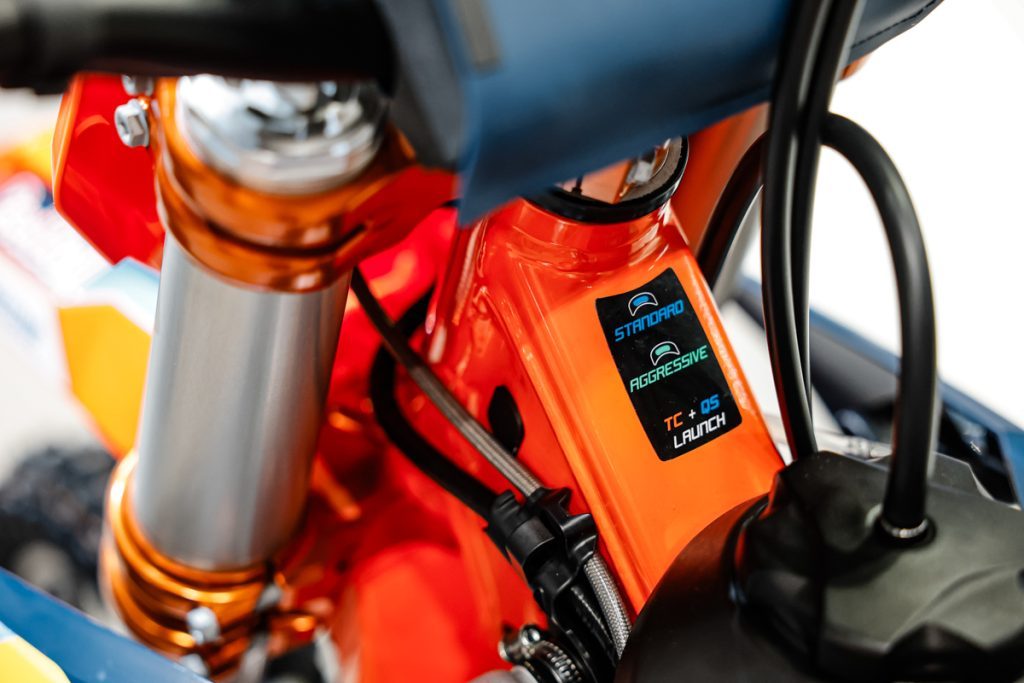
KTM is developing an electronically adjustable off-road suspension system in collaboration with WP. / Photo: KTM
Although EICMA was two weeks ago, we still wanted to share a technical detail presented there that deserved a bit more attention at the Milan motorcycle show. KTM and WP unveiled an electronically controlled off-road suspension system that can automatically adjust its damping while riding. And this isn't just a simple electronic adjustment where you switch between a soft and a hard setting at the push of a button.
The jointly developed system is designed to react to different riding situations and adjust compression and rebound damping in real time. Whether it's deep braking bumps, jumps, whoops, or steep climbs – the electronics are intended to recognize what's happening and intervene accordingly. According to KTM, the technology is already close to series production. Its use in future motocross models is also planned.
Fewer compromises in chassis tuning
Anyone who rides motocross regularly knows the problem. A suspension setup that works perfectly on a fast, relatively flat track can suddenly become unpleasant on a rutted hardpack surface. Deep sand presents different challenges, and it's during hard landings that you'll find out whether the chosen setup offers sufficient reserves.
Of course, a conventional suspension can be adjusted to different conditions. However, this always involves a compromise. A firmer setup can offer advantages under heavy loads, while softer damping handles smaller bumps better. Optimally covering both simultaneously is difficult.
This is precisely where the development by KTM and WP begins.
KTM has been working on electronically controlled suspension systems for street motorcycles since 2013. Two years later, they introduced semi-active systems that automatically adjust damping while riding. The experience gained in this area is now being incorporated into off-road development.
Simply adopting the road-going technology was out of the question. As Fabian Gusta, Lead Off-Road Product Manager at KTM, explained at EICMA, the requirements differ considerably. While riding comfort plays a crucial role in road motorcycles, traction is paramount off-road.
Added to this are the constantly changing stresses. A motorcycle must generate as much grip as possible during acceleration, withstand hard landings, and at the same time remain as stable as possible over small, rapidly successive impacts.
For the developers, this meant designing the electronic control system specifically for off-road use.
How does the electronic suspension work?
Technically, the system combines WP suspension components with a control unit developed by KTM. Sensors in the suspension and information from the vehicle electronics provide the data used to adjust the damping.
The crucial difference to a conventional electronic suspension adjustment is that the control is not limited to a single selected setting.
In a simple system, the driver selects, for example, a sporty or comfortable setting. This setting then remains in place until changed again. The new semi-active suspension, on the other hand, is designed to react automatically to the respective driving situation.
KTM cites jumps, wheelies, whoops, and steep climbs as examples. If the electronics detect a corresponding situation, they can adjust the compression and rebound damping.
The fork and shock absorber can be adjusted independently. Depending on the riding situation, both components can also work together in a coordinated manner. The spring preload is not adjusted electronically.
The exact technical details of how KTM implements the system are not yet fully known. It has only been confirmed that there are no electronic actuators inside the fork or shock absorber bodies. The manufacturer has not yet disclosed which valve technology and sensors are used.
The rider will also retain control over the basic setup. Various suspension modes can be selected via a control unit on the handlebars. These include Comfort, Sport, Classic Enduro, Hard Enduro, SuperEnduro, and MX.
Furthermore, individual adjustments should be possible. The electronics do not simply take over all decisions, but operate within the parameters chosen by the driver.
How would that change things in motocross?
This technology could be particularly advantageous in motocross, where a track can change significantly over the course of a race day.
What appears relatively smooth in free practice can be characterized by deep braking bumps, ruts, and sharp edges in the second timed run. Add to that the varying surfaces within the same track. On one section, the motorcycle needs maximum traction, while just a few meters later, the suspension has to absorb a hard landing.
A conventional suspension system has to cope with all these situations with its chosen basic setup. With a good setup, this already works surprisingly well, but it always remains a compromise.
With electronic control, the damping could behave differently during a jump landing than when driving over small braking bumps. Different loads on the front and rear wheels could also be taken into account more precisely.
For the rider, rideability is more important than pure speed. A motorcycle that remains predictable on an increasingly worn track can conserve energy and inspire more confidence. This is especially crucial over a full race distance.
Whether the new KTM-WP system actually offers this advantage remains to be seen. Independent comparison tests with a conventional suspension system are not yet available.
Furthermore, established suspension manufacturers have spent decades refining their mechanical systems. A modern WP, KYB, or Showa setup is already capable of handling a wide range of loads. Therefore, the electronics would not only need to offer additional adjustment options but also make a noticeable difference under real-world conditions.
Not an option in MXGP for now.
Ironically, there is currently a restriction in professional racing. According to the current FIM regulations, electronically controlled suspension systems are not permitted in the World Championships for Motocross, Enduro, and Rally.
Therefore, participation in MXGP would currently not be permitted. KTM is aware of this situation but considers a future change to the technical regulations to be fundamentally possible. No concrete plans from the FIM for such a rule change are known at present.
This means that the development is initially aimed primarily at hobby and leisure drivers.
And for this target group, the system could be particularly useful. While professional riders and teams regularly adjust their suspension setups, many amateur riders pay comparatively little attention to compression damping, rebound damping, or finding the right settings for different tracks.
It is not uncommon for a setup, once found, to be maintained for months, even though the conditions differ significantly from track to track.
An electronic suspension system could take over some of the setup work here. For example, someone who rides hard enduro one weekend and then goes to a fast motocross track for the next training session could change the basic characteristics at the touch of a button and leave the further adjustments to the electronics.
This wouldn't completely replace traditional suspension setup. Spring rates, spring preload, and the basic mechanical design still need to be suited to the rider and their intended use. However, electronics could expand the range in which a previously chosen basic setup works well.
Mass production is getting closer
KTM has not yet announced a specific launch date. However, the system presented at EICMA is already being described as being close to production-ready.
Before the technology can be ready for market, the functions, hardware, and user interface for individual settings, among other things, need to be fully developed. KTM only wants to offer the technology once the entire system is sufficiently mature.
According to information from Enduro21, an introduction of this feature in enduro and motocross models is planned for a similar timeframe. There is no official confirmation yet regarding specific models or model years.
The price also remains an open question. This is likely to play a significant role, especially with an electronic suspension system. Additional sensors, control electronics, and regulation components incur costs, and long-term durability will also be a consideration.
Ultimately, off-road motorcycles have to withstand a lot. Dust, mud, water, vibrations, and hard impacts are all part of everyday life. Then there's the question of how costly repairs will be if an electronic component fails.
Nevertheless, with this development, KTM could change an area that has remained largely mechanical until now. Engine mapping, traction control, and launch control have long been standard on modern off-road motorcycles. Now, electronic control could also play a greater role in the chassis.
Whether the system actually catches on will depend less on the number of its suspension modes than on how well it performs on the track. If it gives a recreational rider a more controllable motorcycle on different surfaces without constantly having to adjust the settings, that would already be a real improvement.
And should the technology prove successful in series production, electronically controlled suspension systems will likely be discussed again in professional motocross sooner or later. The question of whether such a development should be permanently excluded from MXGP will arise at the latest when it offers a demonstrable advantage on the track.
Reader Comments